Wednesday, 1 November 2017

Pilgrimage to Rome 2017 (3) - After Mass in the Minerva

The Sacristy of Santa Maria Sopra Minerva

The Chapel of Saint Catherine is located behind the Sacristy of the Basilica. The Sacristy itself is an amazing and historic space. It has housed at least two Papal Conclaves, those of 1431 and 1447, to elect Popes Eugene IV and Nicholas V respectively. It can be found behind a gate just to the left of the Gospel-side Transept of the Basilica but, as ever, our intrepid pilgrimages organizer obtained for us access to some of those places in Rome where very few and only seldom go. The decoration of the Sacristy is by Andrea Sacchi in 1600, including the Crucifixion in the niche at the far end of the Sacristy (behind which is the Chapel of Saint Catherine). The ceiling scene of St. Dominic in glory is attributed to Giuseppe Puglia. The fresco of the Roman painter G. B. Speranza is placed on the front door, dating from 1640, and represents two conclaves which took place here. The Barberini bees - a motif that will recur throughout our pilgrimage - appear in several places in the Sacristy. In this case, they are the emblem of Cardinal Antonio Barberini, Archbishop of Reims, known as Antonio the Younger, one of the Cardinals Nephew of Pope Urban VIII. The Barberini family was a great benefactor of the Dominican Order and funded the decoration of the sacristy. The vestment benches and presses are also 17th cent. and are of walnut.


Inside the Basilica of Santa Maria Sopra Minerva

The Basilica is too filled with historic and artistic gems to cover all but those that our group concentrated upon were the tomb of Saint Catherine of Siena under the High Altar (seen below with the tomb of Pope Clement VII Medici behind. Opposite it out of shot the tomb of Pope Leo X Medici, both Florentines with strong connections to the Dominican Order), next to it, the Capranica Family Chapel of the Holy Rosary, where we had Mass on a previous Pilgrimage, the Caraffa Family Chapel with the tomb of Pope Paul IV at the end of the Epistle-side Transept (opposite the Chapel of St. Dominic at the end of the Gospel-side Transept, built for Pope Benedict XIII, the Dominican Pope, and containing his tomb), and finally, just next to the Caraffa Chapel, the tomb of the redoubtable Durandus.


Outside the Basilica of Santa Maria Sopra Minerva

In the Piazza outside the Basilica is Bernini's famous Obelisk supported by an Elephant, erected here by Pope Alexander VII Chigi, the first member of the Sodality of Our Lady (of a total of 20) to be elected Pope and of whom we shall hear much throughout the pilgrimage. Opposite the Basilica is the Palace of the Pontifical Ecclesiastical Academy, or the Academy of Noble Ecclesiastics, the finishing school for Vatican diplomats.

Just around the corner is the discreet - but fascinating - shopfront of Ditta Annibale Gammarelli, Ecclesiastical tailors since 1798, who provided the vestments for our pilgrimage.

Just a few steps up the street is the Pontifical French Seminary and the Seminary Church of Santa Chiara. Across the tiny Piazza di Santa Chiara is the Palazzo di Santa Chiara. This was once a house of Dominican Tertiaries and the actual site of the death of Saint Catherine of Siena. As already mentioned, the room itself where she died was moved into place behind the Sacristy of the Minerva, and the space left by that removal has been replaced by an amazing little chapel of 'Santa Catarina in Transito' which remains open to the public despite the Palazzo now being a public theatre - where some of the pilgrims also attended a selection of operatic pieces one evening of the trip.


Tuesday, 31 October 2017

Pilgrimage to Rome 2017 (2) - Opening Mass in the Minerva

Meeting in the Vatican
Our pilgrimage to Rome works on several levels.  It is a visit to the tombs of the Apostles and the other Saints of Rome.  It is an occasion to spend time together in prayer as a group.  It is an opportunity to experience the sights, sounds and culture of Rome, to see with our own eyes our heritage as Catholics in living as well as in static form.  It is a journey to honour the See of Peter and Our Holy Father the Pope.  As a journey to experience the Catholic culture of Rome and to honour the Holy See, an important element of our pilgrimage is always to pay our respects to officials of the Holy See.  This year, a few of the pilgrims had the honour to begin our first day, just before Mass, with an audience with the Secretary of the Congregation for Divine Worship and the Discipline of the Sacraments, Archbishop Arthur Roche.


Mass in the Minerva
The first Mass of the 2017 Catholic Heritage Association Pilgrimage to Rome took place in the Sacristy Chapel of the Basilica of Santa Maria Sopra Minerva, that is, the Basilica of Our Lady built over the ruins of the Temple of Minerva.  During our 2008 Pilgrimage we had the privilege of having Mass in the beautiful Capranica Chapel dedicated to the Holy Rosary (see here).  This year, continuing our quest 'boldly to go where few men have gone before,' we were granted an even greater privilege to have Mass in the small Chapel of Saint Catherine of Siena, which is the actual room in which Saint Catherine died, and which is to be found behind the wonderful Sacristy of the Basilica (see here), the site of at least two Papal Conclaves.

The Chapel was rebuilt on this site in 1637 on the initiative of Cardinal Antonio Barberini, using the original walls of the room in a nearby house where the Saint died in 1380.  The house itself is now the site of the Palazzo di Santa Chiara on the Via Santa Chiara and the space left by the room is now itself a Chapel (see here) called Santa Caterina da Siena in Transito.

The Cardinal also had the frescoes attributed to Antoniazzo Romano and his assistants placed in the Sacristy Chapel, which had originally had been in the left arm of the transept.  Over the Altar, the Crucifixion and the Saints, on the left wall, the Annunciation with Ss. Jerome and Onofrio, and on the right wall, the Resurrection with Ss. Lucy and Augustine.

The Altar was erected by Pope Benedict XIII, himself a Dominican who is buried in the Chapel of St. Dominic in the left hand transept of the Basilica, decorated by the Filippo Raguzzini on the instructions of the same Pope Benedict XIII.


Monday, 30 October 2017

Pilgrimage to Rome 2017 (1) - Opening Vespers and Benediction

The annual pilgrimage to Rome of the Catholic Heritage Association began this evening with Vespers of the Little Office of the Immaculate Conception and Benediction of the Blessed Sacrament.  The Little Office of the Immaculate Conception was, as usual, the thread of prayer that joined together the various visits and ceremonies of the Pilgrimage.  The Hours of the Little Office were recited during the course of each day of the Pilgrimage.

We returned this year to the Istituto Maria Santissima Bambina, where we had stayed in 2003. The Istituo is one of the most spectacular and memorable places to stay in Rome. The Catholic Heritage Association always favours religious houses as the base for international pilgrimages and was pleased to have the opportunity to return to the Istituto. The House is run by the Sisters of Charity of the Infant Mary, founded in Milan by Saints Vincenza Gerosa and Bartolomea Capitanio, both members of the Sodality of Our Lady. It is a modern building in a part of the medieval Leonine fortifications surrounding the Vatican and is on Vatican Extraterritorial property. The views from the fourth floor terrace are legendary.


Monday, 18 September 2017

The Religious Houses of Roscommon Town (Walsh)

From Thomas Walsh's History of the Irish Hierarchy chapter lix, p. 634 ff:


Roscommon, the capital of the county, and gives title to the lamuy of Dillon, as earls. Sir Robert de Ufford rebuilt the castle of Rosscommon, A.D. 1268, which was razed to the ground in 1271.

Abbey of canons of St. Augustine. St. Coeman was bishop of Roscommon. The monastery of Roscommon was founded by the bishop Coman, who died in 743 or 746. His monastic rule, called the law of Coman and Aodan, was received in three parts of Connaught. Besides the severity of the institute, which the founder himself compiled, this abbey was celebrated for its schools and the number of its learned professors, who continued to teach at Roscommon, until the year 1177, when the English army took possession of the monastery in their route from Dublin to the West of Ireland.

St. Aodan succeeded the founder.

A.D. 777, died the abbot Aodan.

A.D. 807, the Danes plundered and sacked the abbey.

A.D. 811, died Joseph, the learned scribe of Roscommon.

A.D. 813, died the abbot Sedulius, also bishop of Roscommon.

A.D. 816, died the bishop Siedat.

A.D. 872, died the abbot Aodh, the learned and venerable scribe of Roscommon.

A.D. 964, the abbot Cormac O'Kellane, who was bishop and abbot of Roscommon, Clonmacnoise and Tuaimgreny. He was held in universal esteem for his great learning and unbounded benevolence.

A.D. 1043, died Aodhan Connactach, anchorite and prelector of this abbey.

A.D. 1097, the abbot Flanigan Roe O'Dubhtaig, and Aidan, a learned professor, of this abbey.

A.D. 1123, a piece of the Holy Cross was presented to this abbey by Turlogh O'Connor.

A.D. 1135, the professor Gilla Colman O'Conghaly, a scribe and commentator of this abbey, was slain by the people of Conmaicne.

A.D. 1156, Turlogh the Great, monarch of Ireland, died. He largely augmented the estates of this house, and directed the Host to be carried with great solemnity, attended by many of the clergy and other religious men, throughout the kingdom, and then to be deposited in a tabernacle prepared for it, of immense value, in this church.

A.D. 1158, a synod of all the clergy of Connaught was held in this abbey, when many good and exemplary decrees were made.

A.D. 1170, the abbot Dermod O'Braoin, a man of extraordinary erudition, d'ed at Inisclothran, in the county of Longford, in the ninety-fifth year of his age. In the same year, his successor Giolla Jarlaithe
O'Carmacan, placed the remains of the founder, St. Coeman, in a shrine richly ornamented with silver and gold.

A.D. 1177, a party of English arrived here on their way from Dublin and remained three nights.

A.D. 1204, William Bourke, the conqueror of Connaught, spoiled this abbey.

A.D. 1232, Tiopraid O'Braoin, a man well skilled in the antiquities and laws of the country, died on a pilgrimage at Innisclothran.

A.D. 1360, Eoscommon was destroyed by fire.

A.D. 1472, Theobald Burke, a Dominican friar, was, by special bull of Pope Sixtus IV., made prior of the canons regular of Roscommon.

A regular succession of abbots continued until, in the twentieth of queen Elizabeth, its possessions, consisting of thirty quarters of land and various rectories, were granted, at an annual rent, to Sir Nicholas Malbye. A second inquisition was held under James I., when other property, together with the rectories and tithes of eighteen parishes, were seized upon and held from the king in pure and common soccage.

We find none of the abbots or priors of the monasteries of Connaught sit as barons of parliament. Beyond the Shannon, the people were considered as barbarians, and hence they were debarred the advantages which British protection cmd improvement guaranteed. The natives of that province never relaxed in their resistance to English rule until the reign of James 1., when England exercised supreme control.

Dominican friary. This monastery was founded in the year 1253 or 1257, by Phelim O'Conor, king of Connaught, who was interred here, A.D. 1265.

The church was dedicated to the Virgin Mary, and was consecrated by Thomas O'Connor, bishop of Elphin.

A.D. 1261, Murarius Duach O'Conneker was prior.

A.D. 1293, a general chapter of the order was held here.

A.D, 1308, this friary was destroyed by lightning.

A.D. 1445, this house having suffered much from the calamities of war, and other misfortunes, Pope Eugene IV. granted a bull of indulgence, bearing date the 5th of May, to repair the same. This year died Thomas O'Comen, esteemed the most wise and prudent man of his time.

The possessions of this friary, 143 acres of land, with tithes and appurtenances, were granted to Sir Nicholas Malbye, knight. In 1615, they were given to Francis, Viscount Valentia, from whose family they passed into the hands of Sir Arthur Cole, baron of Ranelagh.

Tliis abbey has given martyrs to the church of Ireland, who shall be noticed elsewhere. In 1756 there were sixteen friars attached to this convent: Thomas Mulledy, the prior; Thomas Brennan, master; Thomas Egan, sub-prior; Dominick O'Kelly, James Brenan, Patrick Mac Dermot, Peter Cor, Ambrose Mac Dermot, Jolin Rutledge, I'atrick Kennedy, John Keetly, John Smyth, John Kearney, Michael Cahan, Anthony O'Kelly, and Dominick Hanly. Some of those were exercising pastoral functions.

Franciscan friary of Roscommon was founded A.D. 1269, and in the following year was totally destroyed by fire.

Monday, 24 July 2017

Boyle Abbey (Walsh)

From Thomas Walsh's History of the Irish Hierarchy chapter lix, p. 624 ff:


Boyle, anciently called Athdalarg. See Easraacneirc. A market-
town on the river Boyle.

A.D. 1148, the Cistercians procured a settlement at Grelacdinach. They afterwards removed to Athdalarg or Boyle. Peter O'Morra, a man of great learning, became their first abbot; afterwards promoted to the see of Clonfert, and was unfortunately drowned at Port de Caneog, on the river Shannon, 27th of December, 1171.

Boyle abbey was one of the most celebrated monasteries of Europe. Boyle was filial to Mellifont, and was dedicated to the Virgin Mary.

Aodh O'Maccain succeeded the learned O'Morra. He moved his monks to Drumconaid. His successor, Maurice O'Dubhay, having continued there near three years, removed to Bunfinne; remained in this latter place near two years and six months, when they finally settled at Boyle in the year 1161.

MacDerraot, prince of Moylnrg, erected this noble monastery. The estates of the Macdermots have been seized by the King family, and lord Lorton is the present occupant.

A.D. 1174, the abbot Maurice O'Dubhay died the 27th of December, and was interred here.

A.D. 1218, the abbey church of Boyle was consecrated.

A.D. 1235, the English forces, under the command of lord justice Maurice Fitzgerald and MacWilliam Bourke, encamped within the abbey walls, sacrilegiously seized all the goods, holy vestments, chalices, &c., belonging to this abbey, and very irreverently stripped the monks of their habits in the midst of their cloister.

A.D. 1250, the abbot Dunchad O'Daly, the "Ovid of Ireland," died.  He was superior to all the poets of his time in hymnal compositions.

A.D, 1315, Kory O'Connor pillaged this abbey.

A.D, 1331, MacDermot, lord of Moylurg, resigned his lordship and assumed in this abbey the habit of the order.

A.D. 1342, Dermot Roe MacDermot died here in the Cistercian habit.

A.D. 1383, died the abbot MacDairt, a charitable and humane gentleman.

A.D. 1444, the abbot Thady died at Rome.

At the suppression, Tumaltach MacDermot was the abbot. Patrick Cusacke, of Gerrardstown, in the county of Meath, obtained a grant of the possessions of this abbey, then consisting of 2350 acres in various counties.

A.D. 1603, a second grant of this abbey and its possessions was made to Sir John King.

In the reign of Elizabeth, the abbey of Boyle was converted into a place of defence. Within a few miles of the abbey, on the north side of the Curlew mountains, O'Donnel, on the morning of the 15th of August, 1598, defeated the English troops under the command of Clifford, governor of Connauglit. Every Irish soldier, imitating the good example of their commander, prepared himself for the approaching combat by confession and communion. Scarcely had the divine sacrifice been concluded on the morning of this festival dedicated to the holy and immaculate mother of God, the queen of heaven, and the mother of the afflicted, when the English army appeared slowly advancing with
great order and regularity.

A notion then prevailed among the native Irish, that one of the objects of the reformation was to impugn the virginity of blessed Mary, mother of God. And this notion, which the language of the reformers then as well as the present day too fully justified, impressed such a horror against the English in the minds of the Irish clergy and laity, that it rendered their detestation more intense, and the English, objects of greater abhorrence. O'Donnel, impatient for the combat, which he deemed decisive of his country's fate, harangued his troops in the language of old Ireland, pointing out the advantages which their situation gave them over their opponents. "Moreover," continued O'Donnel
"were we even deprived of those advantages, we sliould trust to the great dispenser of eternal justice, to the dreadful avenger of iniquity and oppression, the success of our just and righteous cause. He has already doomed to destruction those assassins, who have butchered our wives and our children, lundered us of our properties, set fire to our habitations, demolished our churches and monasteries, and who have changed the face of Ireland into a wild and uncultivated desert. On this day more particularly, I trust to heaven for protection, a day dedicated to the greatest of all saints, whom those enemies to all religion endeavor to vilify; a day on which we have purified our consciences, to defend
honestly the cause of justice against men whose hands are reeking with blood, and who, not content with driving us from our native plams, come to hunt us like wild beasts, into the mountains of Dunaveragh. But what ! I see you have not patience to hear a word more. Brave Irishmen, you burn for revenge. Scorning the advantage of this impregnable situation, let us rusli down and shew the world that, guided by the Lord of life and death, we exterminated those oppressors of the human race. He who falls, will fall gloriously, fighting in defence of justice, liberty, his native country ; his name will be remembered while there is an Irishman left, and he who survives, will be pointed out as the companion of O'Donnel and the defender of his country. The congregation shall make way for him at the altar, saying, 'That hero fought at the battle of Dunaveeragh.'"

In this engagement the English lost fourteen hundred men. Clifford's head was struck off, and the cause of the British thrown into confusion by this victory, which the brave and the pious O'Donnel gained. The natives of Dunaveragh still point out the spot where Clifford fell.

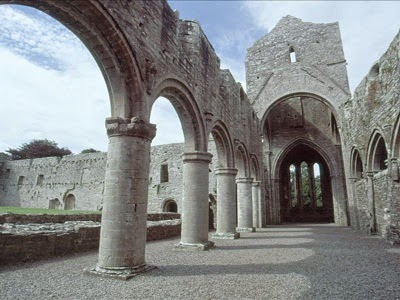
Boyle abbey was once one of me finest buildings in Ireland, and even still in its fallen yet picturesque condition, is signally creditable to the architectural taste and skill of the native princes as well as that
of the clergy, previously to the English invasion.

Its ruins consist of the nave, choir and transepts, with a lofty square steeple in the centic of the cross; the south side of the nave is formed by a range of four lofty circular arches, supported by round piers or columns of considerable solidity. These columns support a lofty wall, on the side which the ivy now mantles, and are still ornamented with some beautifully carved corbels, which once supported the vaulted roofs. The great arches supporting the tower were forty-eight feet high, three of them circular, while the fourth singularly formed a pointed arch; the bases of these columns are traced with various ornamental devices, each studiously difliering from the other, and all equally beautiful.

The eastern window was particularly attractive. It consisted of three jiointed arches, divided by mullions with decorated heads, all tolerably perfect. Some of the capitals are plain, othei-s adorned with carving. The walls round the nave were perforated with a triforium, which opens into the body of the building, through various small circular arches, still traceable behind the ivy. The entrance was at the western end by a small arch pointed door. The stone used in the building is of the most solid description.

Friday, 21 July 2017

Annual Latin Mass in Letterkenny Cathedral

You are warmly invited to join us in prayer for the Annual Traditional Latin Mass in the magnificent Cathedral of Ss. Eunan and Columba at 4 p.m. on 15th August, the feast of the Assumption of Our Lady into Heaven.


Tuesday, 27 June 2017

National Latin Mass Pilgrimage to Armagh 2017

To mark the 10th Anniversary of Summorum Pontificum the Catholic Heritage Association of Ireland made our second pilgrimage to St. Patrick's Cathedral, Armagh.  A report of the first pilgrimage can be read here.  It was a truly National Pilgrimage with members coming from Antrim, Armagh, Cavan, Clare, Cork, Donegal, Dublin, Galway, Kildare, Limerick, Louth, Meath, Monaghan, Wexford and Wicklow - the Four Provinces of Ireland all represented - to assist at Holy Mass and attend our Annual General Meeting held afterwards in the Synod Hall attached to the Cathedral.

However, one element of the pilgrimage above all made it a most blessed occasion, the presence of His Eminence Seán, Cardinal Brady, Archbishop Emeritus of Armagh, to celebrate the Mass.  In his homily, Cardinal Brady reminded the congregation that the Traditional Latin Mass had been the Mass of his Altar service, of his First Communion and Confirmation, and of his Ordination and his First Mass.  He also reminded us that this day, the feast of St. John the Baptist, was his own feast day.  Cardinal Brady is to attend the Consistory on 28th June with Our Holy Father, Pope Francis.  His Eminence was assisted by Fr. Aidan McCann, C.C., who was ordained in the Cathedral only two years ago.  It was a great privilege and joy for the members and friends of the Catholic Heritage Association to share so many grace-filled associations with Cardinal Brady and Fr. McCann and the Armagh Cathedral community.


Monday, 22 May 2017

Drumcliffe Abbey

From Thomas Walsh's History of the Irish Hierarchy chapter lx, p. 646 ff:


Drumcliffe, in the barony of Drumcliffe, formerly a town of some note.

Lanigan is not inclined to assign to St. Columbkille the merit of erecting the monastery of Drumcliffe; he is only willing to admit, as he does with regard to St. Fechin, at Ballysadare, that St. Columba only founded a church in this place. At the time in which not only Columba flourished, but also that in which St. Fechin was cut off by the plague, the erection of a monastery was a work of very little delay, especially when the people or the prince were pleased to sanction and assist in its construction. The Abbé MacGeoghegan writes, that the piety of the early Christians of Ireland was such, that they not only gave food and other necessaries for the wants of their religious houses, but even dedicated some of their families to the service of God, as was the custom with the Jewish people. If the history of the foundation of Imay, Co. Galway, be correct, we are therein assured, that the holy founder was at his monastery in Easdara, when admonished to seek the island of Imay, by an angel, — yet Lanigan will not accord to him the erection of that establishment. A St. Thorian, a disciple of Columba, who followed him afterwards to Hy, is named as having governed Drumcliffe,
as the first abbot. It is again argued, that as a blank occurs in the names of the abbots, until the year 921, St. Columba was not the founder. Drumcliffe does not appear to be singular in this respect. Voids of the same sort occur in the succession of the bishops of our sees. Lanigan also urges the silence of Ware with regard to its foundation, &c. Ware is also silent of the Dominican convent of Clonmel, one of far later date. Ware omits the ancient monastery of Tirdaglas, founded by Columba, son of Crimthan.

A.D. 921, died the abbot of Drumcliffe, St. Thorian or Thorannan. He was also abbot of Banchor, and was honored on the 12th of June. Died also this year the blessed Maolpatrick Mac Moran.

A.D. 930, died the abbot Moyngall, son of Becan.

A.D. 950, died the blessed Flan O'Becain, archdeacon of Drumcliffe, a learned and celebrated scribe.

A.D. 1029. This year Aengus O'Hoengusa, archdeacon of Drumcliffe, with sixty other persons, perished by an accidental fire in an island called Inislanne (territory of Carberry).

A.D. 1053, Murchad O'Beollain, archdeacon of Drumcliffe, died.

A.D. 1077, died Murrogh O'Beollan, comorb of Drumcliffe and St. Columb.

A.D. 1187, the abbey was spoiled by Melaghlin, king of Meath. The wrath of Heaven soon overtook him, having been killed in a fort-night after.

A.D. 1225, died Amlave O'Beollain, archdeacon of Drumcliffe, a man of extraordinary erudition, and in general esteem for piety, wisdom, and unbounded hospitality.

A.D. 1252, died in this abbey Maelmaidoc O'Baollan, comorb of St. Columb, a venerable and hospitable man, and in universal estimation in England and Ireland.

A.D. 1416, this abbey was set on fire by a band of plunderesr; the abbot Maurice O'Coincoil perished in the flames.

A.D. 1503, died the abbot O'Beollan.